Organise your own padel game
A 5-minute guide from PadelPush — how to get four players onto a court without the group chat dying on you.
Open the PDFSomebody has to be the one who says "Thursday, 8pm, who's in?" — and in most padel groups, almost nobody wants it to be them.
Not because it's difficult. Because it's thankless. You chase four adults through a chat that has already moved on, you put your own card down on a court nobody has agreed to pay for yet, and if it falls apart it falls apart on you. So the game that everybody wants doesn't happen, week after week, for want of one person willing to absorb all that.
It doesn't have to work like that. Almost all of it comes down to doing things in the right order — and the order is not the obvious one. This guide is the whole job in five minutes: when to ask and how far ahead, which format to use, who books the court and at what moment, how to handle the money without becoming everyone's bank, and what PadelPush sends on your behalf once it's set up. Get it right and running a weekly game costs you about two minutes a week.
Never played? Read Your First Padel Game first — this one assumes you've been on court.
The chicken and the egg
Every organiser hits the same wall on their first game: do you book the court first, or find the people first? Both ways fail, and they fail differently.
- —Court first. You book Thursday 8pm, then ask around. Now you own a bill nobody has agreed to pay, and you're negotiating from a position of weakness — "who can do Thursday 8?" is a much worse question than "when can you play?". If it doesn't fill, you eat it or you beg.
- —People first. You agree a time with three friends, go to book — and 8pm is gone. So you go back to the chat, propose 9pm, one person drops out, and by the fourth round of messages everybody has stopped reading.
The answer isn't a trick, it's lead time. People-first only works when there's still a court left by the time you've agreed. A week out at most clubs, 8pm Thursday is still there. Two days out, it isn't. Start early enough and the chicken-and-egg problem quietly disappears.
So: people first, court second — booked the moment it fills.
Two exceptions where you book first:
- —Prime time at a busy club (weekday evenings, 7–9pm). If it's gone in 48 hours, secure it — but only if you can cancel free (see the money, below).
- —You already have the court. A regular slot, a club block, a friend's cancellation. Then the game is just "who's in?", which is the easy half.
If you do book first, say so and put a deadline on it. "Courts are booked, €15 each, I release whatever isn't taken by Tuesday evening" turns your risk into everyone else's urgency — and it's the one message that reliably converts a chat full of "yeah, I'd play" into four names.
How PadelPush handles it: you set the match up without a court. It sends the invites, chases the silence, and reminds you to book once the match is full — confirmations to the players go out after that. So there's never a moment where you're holding a court nobody has said yes to.
Why the group chat can't finish the job
Watch what happens in any padel group when somebody asks "anyone up for a game near me?":
- 1Four people say yes. Real players, real intent.
- 2Someone posts a poll — 5–7pm or 7–10pm. Three votes to one.
- 3"So we have a team! Friday evening?" — "Can’t do Friday." — "After 7pm and I’m in."
- 4It resets: "Anyone free Monday or Tuesday instead?" — "Tuesday works." — "Tuesday, but 1–4pm." — "That’s roasting."
- 5Day three. No date, no court, no game. Someone new asks "which day is this?" and the honest answer is "no day yet".
Nobody did anything wrong. A group chat simply can't do the four things that turn interest into a game:
- —Close. A poll never ends — it just stops getting votes.
- —Hold a seat. "I'm in" on Monday isn't a seat on Thursday, and nobody knows whether they're one of the four.
- —Count to four. Eleven messages across two options don't tell you if any single slot has a foursome.
- —Book. No poll ever booked a court.
What to do instead: when the "anyone up for a game?" message appears, don't answer it with a poll — answer it with a link. Set the match up (fixed time, or 2–4 options if you genuinely don't know), drop the link into the chat, and let the replies land somewhere that can count them, hold the seats, and tell you the moment you've got four.
A group chat is a great place to find players. It's a terrible place to finish.
Give it at least a week
The single biggest predictor of whether your game happens is how far out you asked.
- —People's weeks fill up. Ask on Monday for Thursday and you're competing with plans that already exist. Ask ten days out and you're the plan.
- —Good court times go 3–7 days ahead. Sunday morning and weekday evenings are the first to go.
- —You need room for round two. Somebody will drop out — that's not pessimism, it's the base rate. A week gives you time to refill without panic; two days doesn't.
| 7–10 days out | Set the amount per head and how you're paid, then invite — more people than you have seats |
|---|---|
| The moment it fills | Book the court and enter the court number. Nothing goes out to the players until you do — that’s what releases the confirmations |
| Day of | Nothing. The reminder sends itself; you turn up 10 minutes early |
This is also why the court availability inside PadelPush behaves differently depending on how far out you are: more than two weeks ahead there's nothing live to show yet; in the middle it shows you what's free but warns you it can change; inside three days it tells you to book now, because that court will not be there tomorrow.
Three ways to fill a game — pick the right one
Most failed games are the right idea in the wrong format.
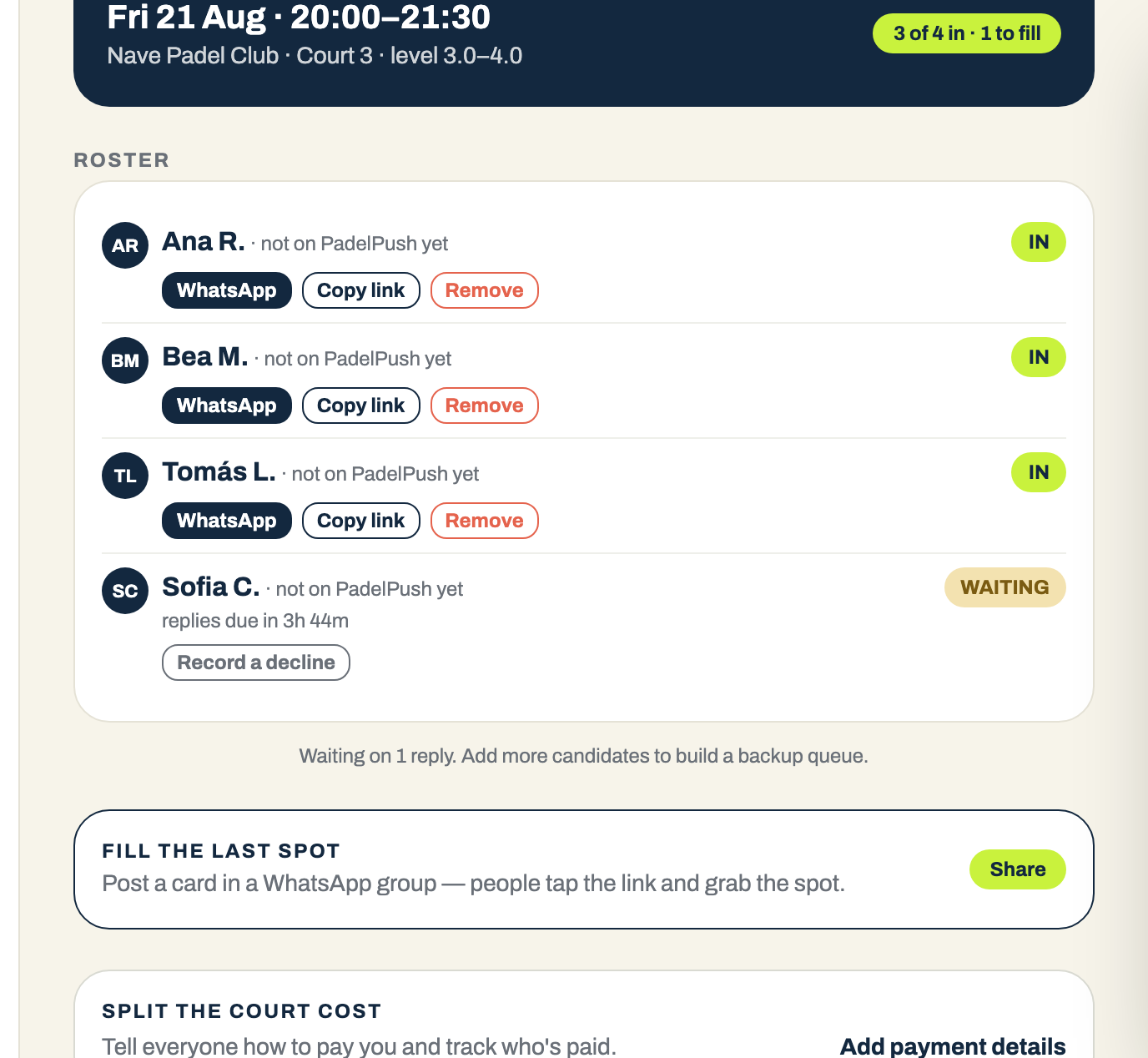
1. Fixed time
You know the time, you roughly know the four. "Thursday 8pm at Nave, who's in?" Everyone gets the same invite and the first yes takes each spot. Fastest possible fill, no decisions for you afterwards. This is the default and it's right most of the time.
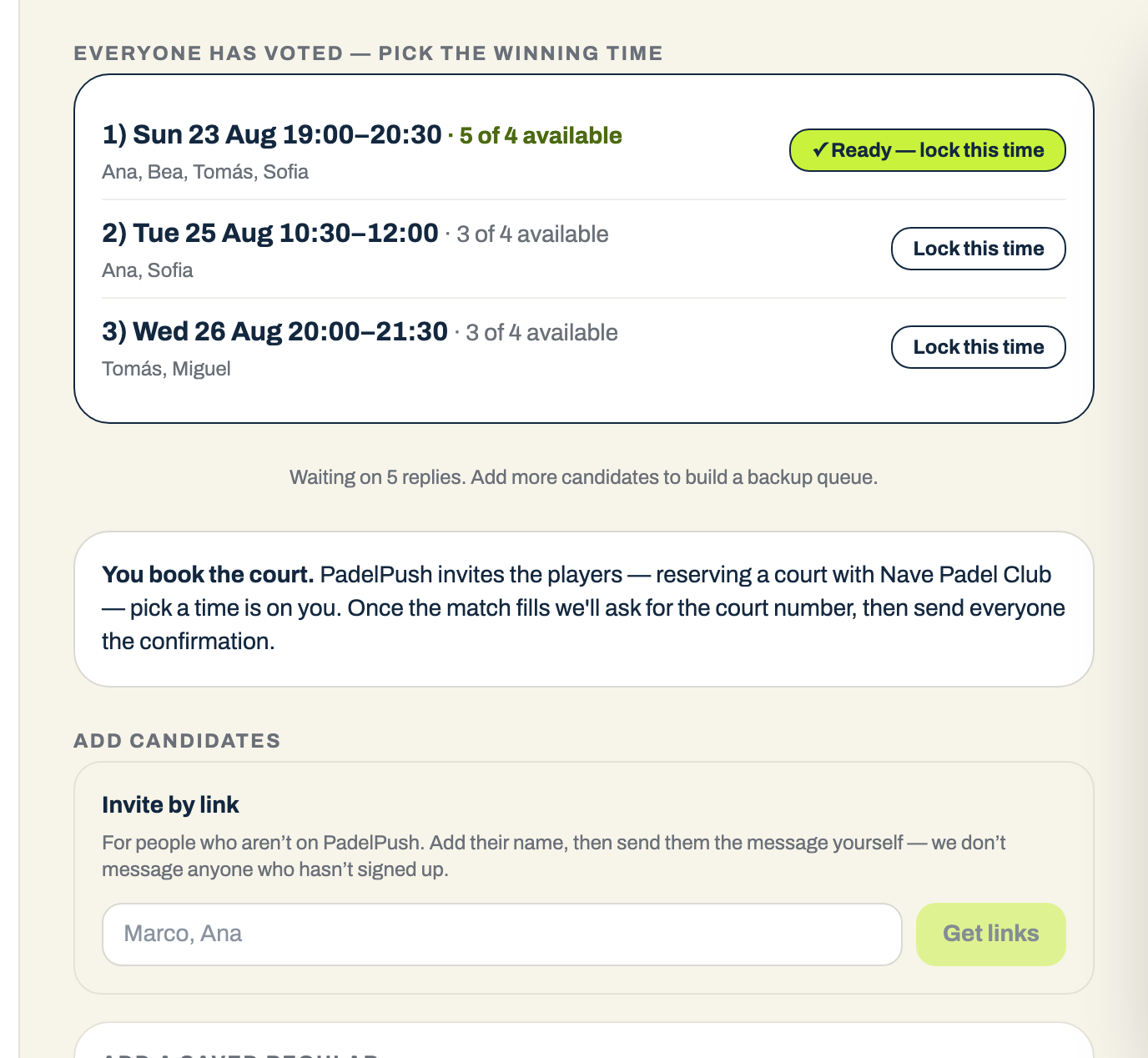
2. Let players vote on the time
One match, no time locked yet. Offer 2–4 options; invitees tick what works; you book the one that wins. Use this when the four people you actually want are hard to pin down — it converts "when can everyone play?" from a twelve-message argument into four taps. The cost is a day of latency, which is exactly what your week of lead time is for.
3. A blast — fill several matches at once
You have more players than one court, or you have no idea who's free. Offer a few time options to a whole group — either message players directly, or drop one link into a WhatsApp group you already have (no sign-ups, no typing in phone numbers). Replies land on a board and you build matches four players at a time. Nobody is confirmed until you place them.
A blast is the right tool when you're trying to grow a regular thing — it turns one message into two or three games. It's the wrong tool for "my usual four on Thursday", which is just a fixed game with extra steps.
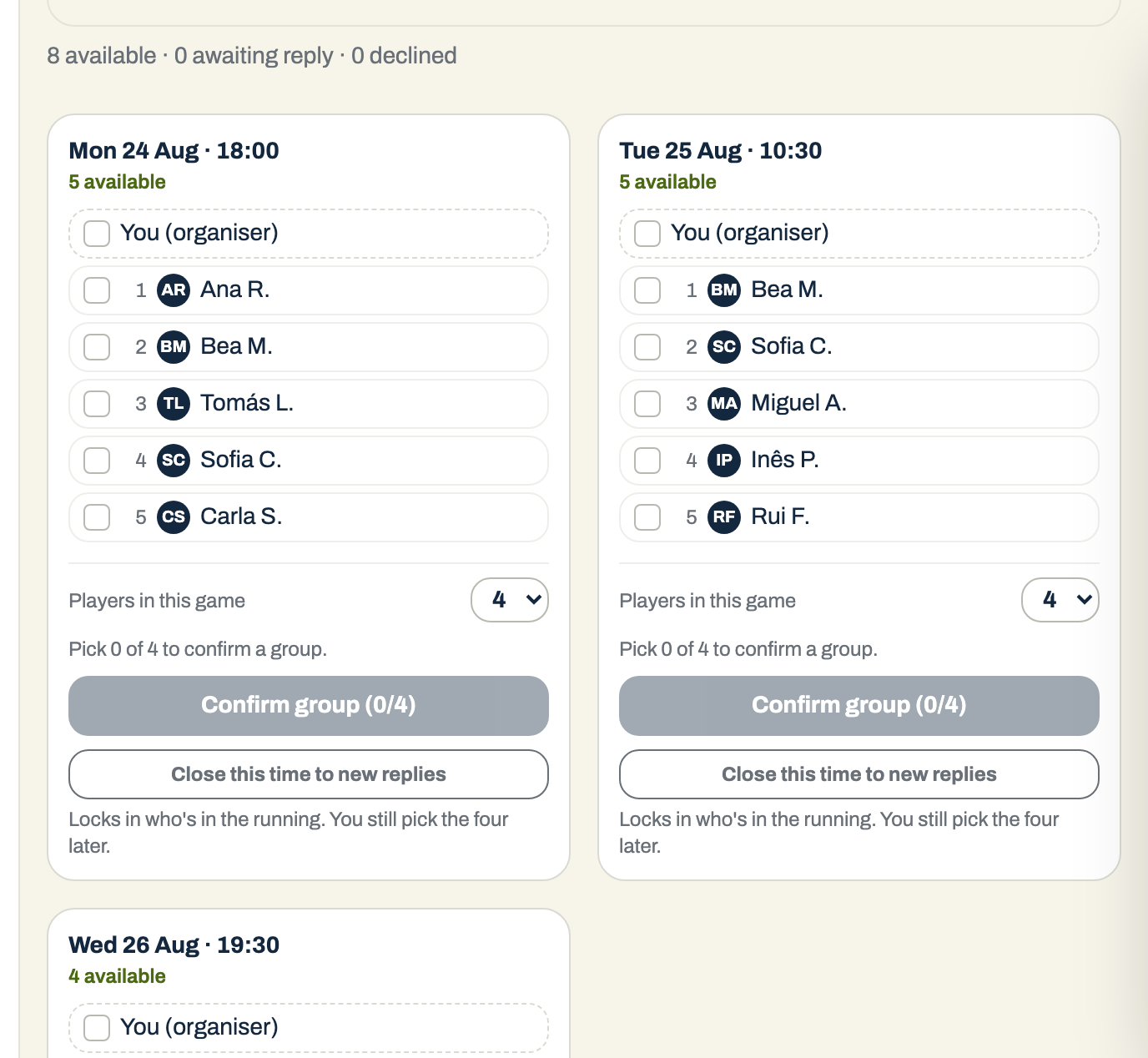
Nobody gets booked into two games by accident. A ticked slot means "I'm free then", not "I want two games" — and PadelPush never reads it as the second thing. If a player is already confirmed for one time in your blast, their own page asks them: "You're already confirmed for Thursday. Still want Sunday as well?" — yes keeps them in both, no takes them off that time and leaves their other votes alone. And if you go to place them in a second match yourself, the board stops you first: "they picked several times, not all of them." You can confirm anyway; you just can't do it silently.
That matters because a player booked into a game they didn't want is a no-show, and a no-show strands three people on a court they've paid for.
And when someone drops out: don't cancel, and don't re-run the whole invite. Post the open spot as a card into a WhatsApp group — people tap the link and grab it. One dropout should cost you one message, not a game.
What gets sent, and when
The reason organising on PadelPush is less work than organising in a chat isn't the setup — it's that seven or eight messages go out over the following week and you write none of them.
While it's filling
- —The invite. A message, by name, with the time, the place and a link. They tap through and answer on the page — no account needed.
- —The chase. Anyone who's gone quiet gets one automatic nudge, halfway through your reply window (three hours on the normal setting). You choose the pace when you create the match: fast, normal or relaxed.
- —The "you're in". Instant, the moment they say yes. If they can't make it but name other times that work, that availability is saved and passed to you instead of evaporating.
- —"You missed out." When the last spot goes, everyone still pending is told honestly and immediately — nobody is left wondering whether they're playing.
- —A nudge to you if the queue runs dry before the match fills, so you can widen it while there's still time.
When it fills — the one step that's yours
Book the court, then enter the court number. That is what releases the confirmations: until it's in, PadelPush deliberately holds every confirmation back, because a "you're confirmed" message that can't say where to stand isn't worth sending. The confirmation then carries the date and time, the venue and the court, who else is playing, a calendar link — and, if you set a pay destination, the amount and where to send it.
On the day, and if it doesn't come together
- —Everyone gets a match-day reminder — the time, the venue and who organised it — sent once, in the morning, and never in the middle of the night (it respects quiet hours and slides to the previous evening for an early game).
- —If you call it off, everyone active gets the honest version — "not enough players", never a face-saving "it filled up". That honesty is why people reply to your next invite.
When someone drops out
Somebody always does. This is the part that kills a game arranged in a chat, and it's the part that costs you the least here. A drop from a full match fires two messages at once:
- —The three still in hear it straight away: "Sam dropped out, so it's not full anymore. We're finding a replacement — you're still in (3 of 4). We'll confirm once the spot's filled." No silent limbo, no rumours in the chat.
- —The waitlist gets asked: "A spot just opened on Ana's match Saturday 18:00 — still in? Tap the link, first to say yes takes it." First yes wins.
Your waitlist builds itself. This is the real reason to invite more people than you have seats: anyone who said yes after the four were taken isn't turned away, they're waitlisted and told so at the time. They're already keen, already know the time and place, and they're the fastest possible refill.
No waitlist? The invite queue picks up where it left off and invites the next person on your list automatically. And if the queue is empty too, post the open spot as a card into a WhatsApp group — people tap the link and grab it.
Two more things run on this same path, which is why it's worth trusting: an unpaid seat past its hold deadline is released exactly like a drop-out, and a refilled match confirms itself. The only decision left to you is the one a human has to make — play as three, or call it off.
Why this is harder on Playtomic
Playtomic is where the courts are. It is not where the games are, and it's worth being clear about the difference.
The level ranges are the big one. An open match advertised as "2.0–3.5" is not a level, it's a shrug. Ratings start as a self-assessment, they only move on results inside Playtomic's own system, and they drift between cities and countries — a 3.0 in one town plays like a 2.0 in the next. On a competitive match Playtomic sets the range itself, anchored to that same wobbly number; on a friendly one it's the creator's to choose, and it tends to get set wide, because a narrow range doesn't fill. Either way you pay up front, show up, and find out. When it's a mismatch, all four of you have a bad hour: one pair is bored, the other is embarrassed.
The other frictions stack on top:
- —You can't choose who you play with, and they can't choose you.
- —The time is fixed — nobody's negotiating it with you.
- —You pay before you know who's coming.
- —The match can fail to fill and vanish, and now your evening is empty.
What it's genuinely good at: telling you which courts are actually free, and taking the money. That's real, and you should use it for exactly that.
The split that works: use the club's booking system for the court, and PadelPush for the people. Invite players by name. Say the level in your own words — "intermediate, beginners welcome" tells a human more than "2.0–3.5" ever will. Keep the same four coming back, so the fifth game takes one message instead of twenty.
Covered or not? Ask before you book
Nobody thinks about the roof until they're standing under 35°C on a glass-walled court with no shade. It's the cheapest mistake to avoid and the one nobody warns you about.
- —Summer middle-of-the-day is brutal uncovered. Glass on four sides, sand on carpet, no breeze — it plays hotter than the forecast says. Those 13:00–16:00 slots are free for a reason.
- —Winter flips it. Covered courts are the first thing gone the moment rain is forecast, so an outdoor booking made a week out is a bet on the weather.
- —Book the shoulders of the day outdoors — before 10:00 and after 18:00 in summer — and save the covered courts for the middle.
- —Check the lights before booking anything after sunset, and expect covered courts to cost a little more.
PadelPush tells you which it is. Pick a club while creating a match and the court list says how many courts there are and how many are roofed — "5 courts · all covered" — with each free slot marked N free · outdoor only in amber when none of them are. Booking somewhere we don't have that? Ring and ask; it's one question.
Then put it in the invite. "Court 3, outdoor — bring a cap" is what stops somebody turning up in black kit at two in the afternoon.
The money: know which kind of club you're at
This is the part that quietly stops people from ever organising a second game. There are two kinds of club and they need completely different tactics.
Clubs where you can call to reserve
A lot of clubs — especially off-peak, and especially if they know you — will hold a court on a phone call or a WhatsApp message and take the money at the desk on the day. Nothing is at risk. You can hold the slot while the game fills, and let it go politely if it doesn't.
If you organise regularly, this is worth five minutes of your life: ring your club and ask whether they'll reserve without prepayment. The answer is yes more often than people assume, and it removes the whole problem.
Clubs where you pay up front
Most Playtomic-integrated clubs charge the card at the moment of booking. Whoever books fronts the whole court — €30, €40 — and then chases three adults for their share. That's the real reason organisers burn out. It isn't the admin, it's being everyone's creditor.
- 1Know the free-cancellation window. Most prepay bookings can be cancelled at no cost up to 24 hours before. That window is your safety net: it lets you book early and back out free if the game doesn't come together. Check your club's actual window before you rely on it — some are shorter, and a few don't have one at all.
- 2Collect before you book, not after. If the four shares are already in your account, booking costs you nothing and chasing nobody. This one change is the difference between organising once and organising every week.
- 3Never front the money as a habit. Once as a favour is fine. Every week is a subscription you didn't sign up for.
How PadelPush helps with the split
- —Set it up before it fills: how you want to be paid — a Revolut, PayPal.Me, Stripe, Monzo, Wise, bunq, SumUp or Tikkie link, or an MB WAY number or IBAN — and the amount per head.
- —The ask rides on the confirmation. Do that, and the "you're in, here's the court" message every confirmed player gets also says what they owe and where to send it. No separate money message to remember, and no gap between someone being confirmed and being asked — which is the gap they forget in.
- —Added your details late? One tap sends the request to everyone confirmed, in a message from us.
- —A board shows who's paid. Whoever hasn't gets one automatic reminder, so you never have to write "hey, just a reminder 🙏" in a group chat again. Anyone paying cash at the desk gets marked pays on arrival and stops being nudged.
- —You can require payment to hold a spot. Unpaid spots release after a set number of hours and go back into the game — you're warned six hours before it happens, and nothing is ever released inside three hours of the match.
- —The money goes straight to you. PadelPush never touches it and never holds it — it's your link, your account.
Money etiquette
- —Say the number in the invite. "€8 each" up front prevents every awkward conversation that follows.
- —Split it evenly, including yourself. Organising is not a job that earns a free game — and charging yourself the same keeps everyone relaxed about it.
- —If someone drops and the spot refills, they get their money back. If it doesn't refill, that's what a reliability record is for, not a fight.
- —Chase in private, not in the group. Or better: let the reminder do it.
Five habits of organisers people say yes to
- 1Invite more people than you have seats. Four invitations for four spots is a game that fails on one "sorry, can't". Invite eight.
- 2Be honest about the level, in plain words. "Relaxed intermediate, we rally more than we smash" fills better than any number, and nobody arrives disappointed.
- 3Answer everyone. A quick "not this time, but I'll ask you first next week" costs ten seconds and keeps someone on your list. Silence is how you lose your bench.
- 4The same time every week beats the perfect time once. Regularity does the organising for you — after a month, people hold the slot themselves.
- 5Play in your own game. You're organising because you want to play. Fill your own seat first, then the other three.
Ready to run one?
Every game on PadelPush was set up by a player, not a club and not a company. Setting one up takes about two minutes, and after that the chasing isn't yours:
- —Invites, replies, reminders and dropout refills are handled for you.
- —Your friends don't need PadelPush — add anyone by name and number, and they can reply without an account.
- —You choose how spots get filled: everyone at once (first yes wins), invite a pool and pick the roster yourself, or one invite per spot in order.
- —You stay in control of the court and the money. We remind you to book; you book. We ask for the shares; they land in your account.
New to padel yourself? Read the first-game guide
PadelPush · weekly padel, organised · padelpush.co